
How Americans Draw the Line on AI in Healthcare
By: Shree Manivel, 2026 Andrew Kohut Summer Scholar*
Over the past decade, artificial intelligence (AI) has gone from a subject of science fiction to something many Americans interact with daily. Movie recommendations from your streaming service, spam filters, and fitness trackers all rely on AI, and these uses have become so routine and noncontroversial that most users may not think much about the technology behind them. Healthcare is a different story. Public willingness to accept AI in healthcare settings depends heavily on what AI is actually being asked to do. Polling data archived in the Roper Center for Public Opinion Research’s Roper iPoll database suggest that Americans are more open to AI handling routine administrative tasks than taking part in medical diagnosis or treatment decisions.
Defining what is being measured
Before explaining findings from the data, it is worth being precise about what this project aims to measure. Research about patient perceptions often focuses on dependent variables like trust in the healthcare system, satisfaction with care received, or how personalized and attentive that care feels. The Roper iPoll database, however, contains several surveys on a somewhat different yet highly relevant topic in today’s healthcare environment: willingness to accept the role of AI in healthcare. At its core, this project explores how the public responds to three different roles for AI in healthcare: handling administrative tasks, serving as a source of health information, and participating in medical diagnosis or treatment decisions. The question about administrative tasks asks whether respondents would want their healthcare provider to use AI for routine paperwork. The question about health information measures whether respondents actually used an AI tool for health information in the past year. Finally, the questions about diagnosis and treatment decisions ask how comfortable respondents are with AI making or helping make medical decisions. Hence, the data below should be read as three related but different kinds of evidence, rather than three points on one continuous scale.
Three roles, three different numbers
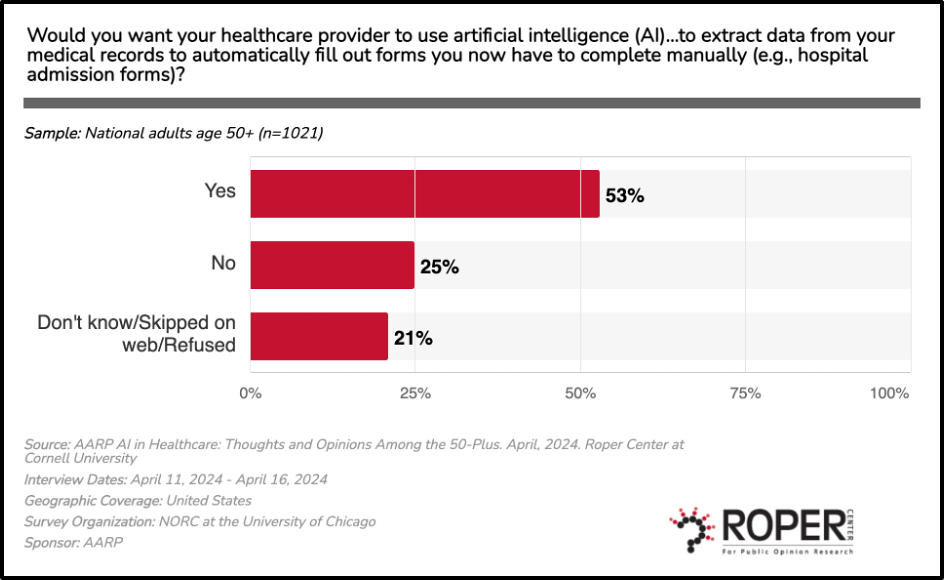
A 2024 National Opinion Research Center (NORC) survey, conducted for AARP among adults 50 and older, asked respondents whether they would want their healthcare provider to use AI to extract data from medical records and automatically fill out routine forms. 53% of respondents said yes.
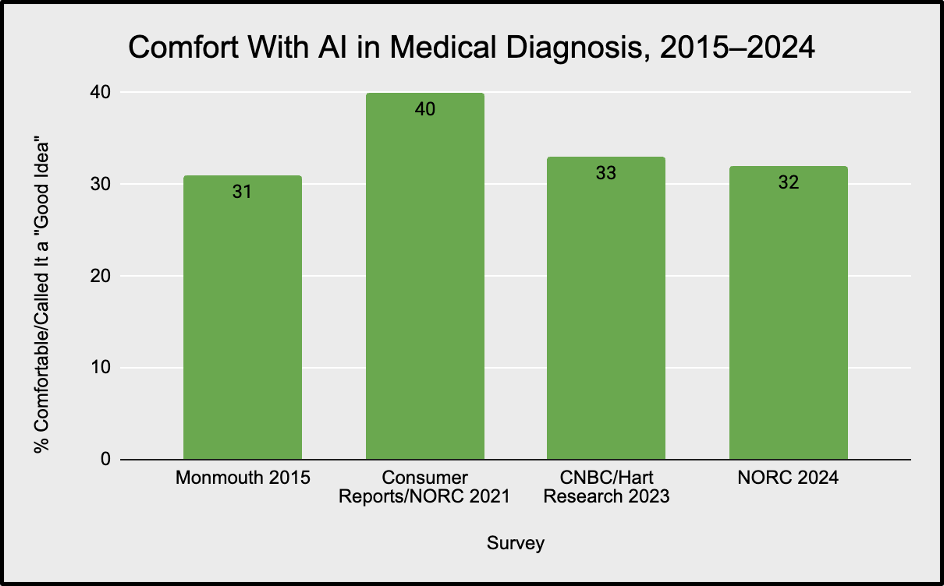
When it comes to diagnosis and treatment decisions, four separate surveys from three different survey organizations asked about AI making, helping make, or replacing humans in medical decisions. The surveys spanned nine years. Monmouth (2015) found that 31% of respondents called it a “good idea.” Consumer Reports/NORC (2021) found 40% of respondents said they felt “comfortable.” CNBC/Hart Research (2023) found that 33% of respondents were comfortable. Consumer Reports/NORC (2024, using nearly identical wording as the 2021 question) found that 32% of respondents were comfortable. Across these four polling snapshots, the share of respondents expressing comfort with or a positive view of AI’s involvement in diagnosis or treatment decisions falls within a relatively narrow range of 31% to 40. Although the questions are not identical, the available surveys do not show an obvious increase in comfort even as the underlying technology has become more advanced.
 Additionally, a March 2026 KFF survey asked respondents whether they had used an AI tool such as ChatGPT, Gemini, or Claude for health information in the past year. Only a minority of respondents said that they had used an AI tool for questions about physical health (29% of respondents) and questions about mental health (16% of respondents).
What the comparison shows
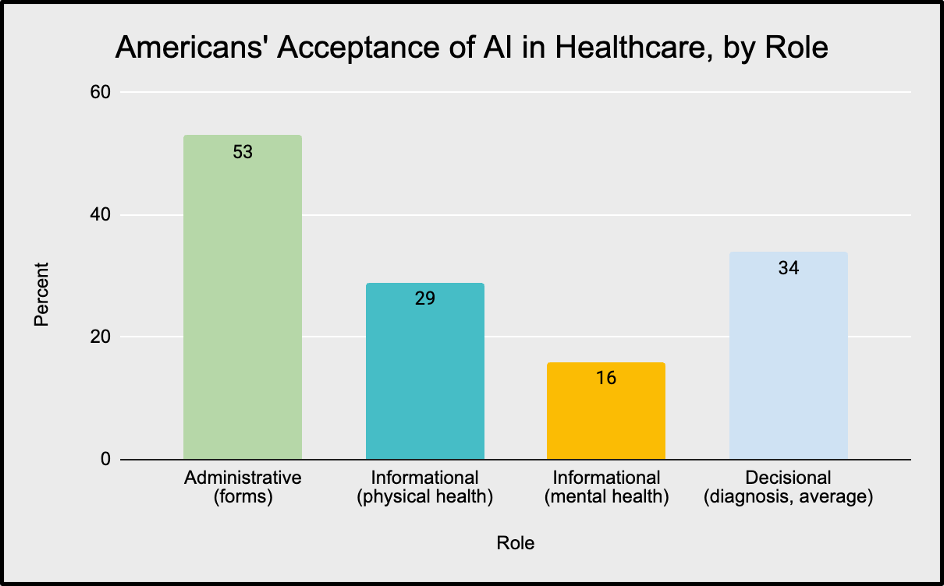
Among the different roles for AI compared here, support is highest for administrative tasks, at 53%. By comparison, across the four surveys about AI’s involvement in diagnosis or treatment decisions, the average share expressing comfort or a positive view is 34%. Separately, 29% of adults report actually using AI for physical-health information. Average comfort with AI in a decisional role (34%) and reported use of AI for physical health information (29%) are relatively close, even though one measures a hypothetical attitude and the other measures real behavior. A meaningful share of the public has already started using AI for health information on their own, at a rate approaching the level of comfort people report with a much more sensitive application: AI helping make an actual diagnosis. Reported use of AI for mental-health information is lower, at 16%. Overall, outside of administrative uses, none of these data points exceed 40%, whether the question measures a hypothetical scenario or actual behavior.
Why this matters
These findings suggest that Americans’ feelings about AI in healthcare depend heavily on how it is used: while a majority support AI taking on administrative tasks, substantially fewer are comfortable with AI playing a role in medical decision-making. At the same time, the available polling snapshots suggest that comfort with AI in a decisional role has changed relatively little over nearly a decade, even as AI technology has advanced and people have begun using it directly for health information. This suggests that public attitudes may depend less on whether AI is being used at all and more on the specific role (task) it is used for. Together, the findings suggest that the specific role AI plays matters. Administrative uses receive substantially greater stated support, some adults are already using AI themselves for health information, and decisional uses continue to receive considerably less stated acceptance.
Who is using AI for health information?
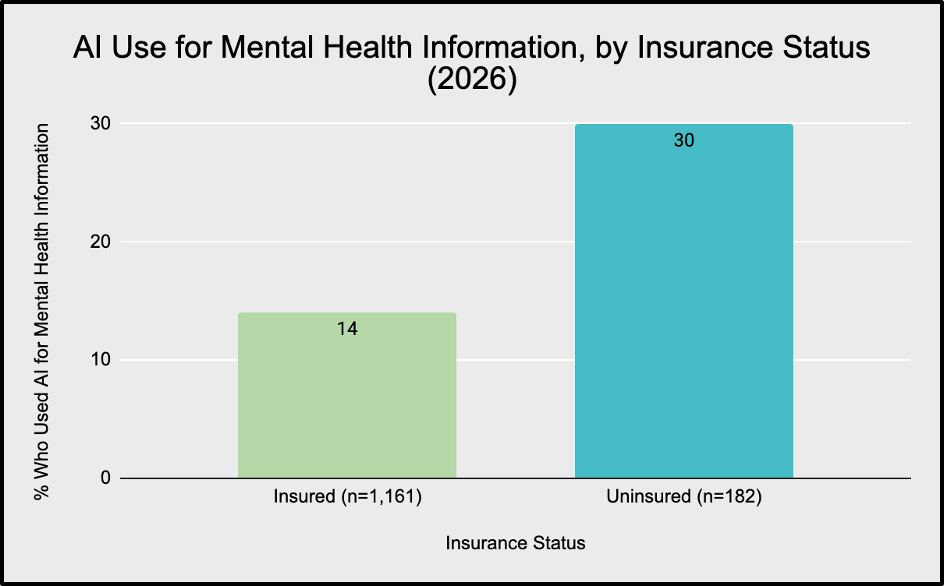
The KFF survey also provides crosstabs that show differences in who reports using AI for health information. One of the largest differences appears by health insurance status. Among adults without health insurance, 30% reported using AI for mental-health information in the past year, compared with 14% of insured adults. Of note, the uninsured subgroup is a smaller sample size, with 182 respondents compared with 1,161 insured respondents. Estimates based on smaller sample sizes are generally less precise, so the true share of uninsured adults using AI for mental health information could be somewhat higher or lower than 30%. However, the difference between the two groups is large enough to warrant further research on this topic.
This difference also raises another question about why people are using AI for health information. Informational AI use may not be explained only by comfort with the technology or interest in trying something new. For some people, AI may also provide another source of health information when access to traditional care is limited. The survey itself cannot establish that lack of insurance caused greater AI use, but the difference is consistent with existing research showing that people use alternative sources of health information when they encounter barriers to care.
Methodological limitations
There are certain limitations to consider when interpreting these comparisons. The data on AI involvement in medical decision-making come from four independently worded surveys rather than a single question tracked consistently over time. Therefore, the available data should be understood as an approximate summary of several polling snapshots, not as a precise longitudinal trend. The administrative-use and health-information-use data each come from a single survey.
The measures also ask respondents about different things. The decisional questions measure stated comfort with hypothetical uses of AI, while the KFF questions measure whether respondents report actually using AI for health information. Direct numeric comparisons across these roles should therefore be interpreted as suggestive rather than as evidence that they measure one underlying attitude toward AI. As the next phase of this project, I plan to examine additional crosstabs for the decisional questions and determine whether these patterns differ across demographic groups.
What does this mean going forward?
When put into conversation with one another, the available polling data suggests that public acceptance of AI in healthcare varies substantially depending on what AI is being asked to do. Americans are most accepting of AI for administrative tasks, while fewer are comfortable with AI taking part in medical diagnosis or treatment decisions. At the same time, a meaningful share of adults are already using AI themselves to obtain health information.
For clinicians, health technology companies, and policymakers introducing AI into healthcare settings, this variation by role, not a blanket verdict on AI use in general, is what is most important. Public attitudes toward AI cannot necessarily be understood through a single measure of whether people “trust AI” or are comfortable with AI generally. The available data instead suggest that acceptance of AI depends in part on the specific role it plays and how much authority it is given in a health-related decision.
References
AARP. (2024). AARP AI in Healthcare: Thoughts and Opinions Among the 50-Plus (Version 2) [Dataset]. Roper Center for Public Opinion Research. doi:10.25940/ROPER-31122054
CNBC. (2023). CNBC All-America Survey (Version 1) [Dataset]. Roper Center for Public Opinion Research. doi:10.25940/ROPER-31120489
Consumer Reports. (2021). Consumer Reports American Experiences Survey (Version 1) [Dataset]. Roper Center for Public Opinion Research. doi:10.25940/ROPER-31118768
Consumer Reports. (2024). Consumer Reports American Experiences Survey (Version 1) [Dataset]. Roper Center for Public Opinion Research. doi:10.25940/ROPER-31122306
KFF. (2026). KFF Poll: March 2026 Health Tracking Poll/Tracking Poll on Health Information and Trust (Version 3) [Dataset]. Roper Center for Public Opinion Research. doi:10.25940/ROPER-31125033
Monmouth University Polling Institute. (2015). Monmouth University National Poll: March 2015 (Version 2) [Dataset]. Roper Center for Public Opinion Research. doi:10.25940/ROPER-31113655
* Artificial Intelligence (AI) was not used in the development of this analysis article.