
Winning Trade Without Winning Hearts
Latin American public opinion and the U.S.–China contest, 2001–2024
By Dayra Lascano, Kohut Scholar, Roper Center for Public Opinion Research*
Twenty-three years of survey evidence from six Latin American countries show that China's economic ascent did not purchase mass affection: already liked in 2001 when almost nobody could rate it, China stayed liked through two decades of deepening interdependence, then lost 13 to 24 points in every country during the pandemic, and in 2024 trailed the United States everywhere, now that everybody knows it. Crisis-stricken publics did not reach for external saviors, and broad support for regional integration reveals almost no distinctly regionalist constituency. These insights come from questions that were largely retired from active surveys as the rivalry U.S.-China intensified; the evidence survives because archives kept the data.
The missing layer of the China debate
Policy discussion of the U.S.–China contest in Latin America runs almost entirely on ledgers — trade shares, lending volumes, infrastructure projects, votes at the United Nations. What Latin American citizens make of the two powers, the layer on which elected governments ultimately stand, is usually asserted rather than measured. A Kohut Scholar project at the Roper Center now measures it, harmonizing comparable survey items across the full 2001–2024 window for Argentina, Brazil, Chile, Ecuador, Mexico, and Peru. These countries were chosen due to their varying economic exposure to China, their regional architectures, and their U.S. ties. The evidence comes from the only two places it exists. The first is a cluster of eight U.S. government surveys from 2001 preserved in the Roper Center's Latin American Databank; the second is the Latinobarómetro series, whose China question begins, fittingly, in 2001 itself.
2001: affection before acquaintance
The starting point defies intuition. In late 2001 — the weeks of China's WTO accession and Argentina's economic collapse — Latin Americans who could rate China already liked it. It stood at 75 percent favorable among urban Chileans with an opinion, ahead of the United States at 68, and at 67 percent among Brazilians, ahead of the United States at 59. What China lacked was not goodwill but acquaintance — a third of Brazilians could not rate it at all, two to three times the American figure. And familiarity's absence had a hard economic edge. When Brazilians were asked which country or group was their closest economic partner, 44 percent said the United States, 29 percent Mercosur, and exactly zero respondents chose China, though it sat printed on the card. The same surveys captured a region whose regionalism was already strained, with Brazilians endorsing Mercosur's benefits two to one while the modal Argentine answer, mid-collapse, was that the country benefited “not at all.” Argentina's agony, meanwhile, produced no rush to external rescue. Eighty-eight percent blamed domestic actors, 12 percent trusted the government to use the IMF's new loan, and only 20 percent wanted to replace the peso with the dollar.
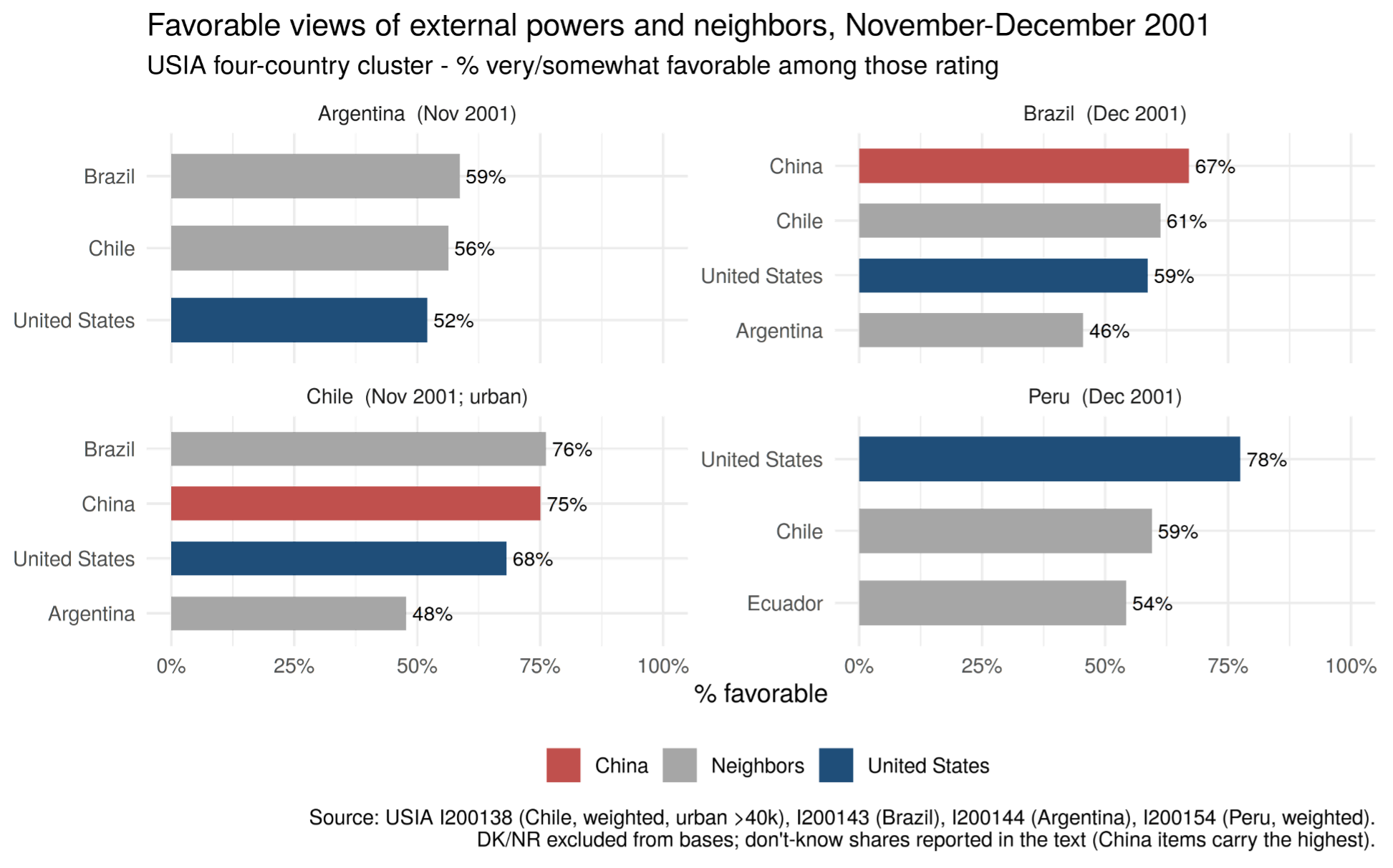
Figure 1. The 2001 anchor: favorable views of external powers and neighbors (USIA cluster, weighted where distributed; percentages among those rating).
The arc: two decades of affection, one late rupture
The full Latinobarómetro record — nineteen waves for China, twenty for the United States, same house and question family throughout — overturns the intuitive story of gradual disenchantment. China's standing did not erode as dependence deepened; it held or rose across the entire boom, with Chile at 86 percent favorable among raters in 2006 and still 85 as late as 2017, and Peru at 87 in 2009. Through the mid-2000s China out-polled the United States by enormous margins, such as 76 to 21 in Iraq-era Argentina in 2006. The break, when it came, was late, synchronized, and sharp: between the 2018 and 2020 waves, favorability fell 13 to 24 points in all six countries at once, bottomed in 2023 at 46 to 50 percent across the Southern Cone, and has recovered only partly since.
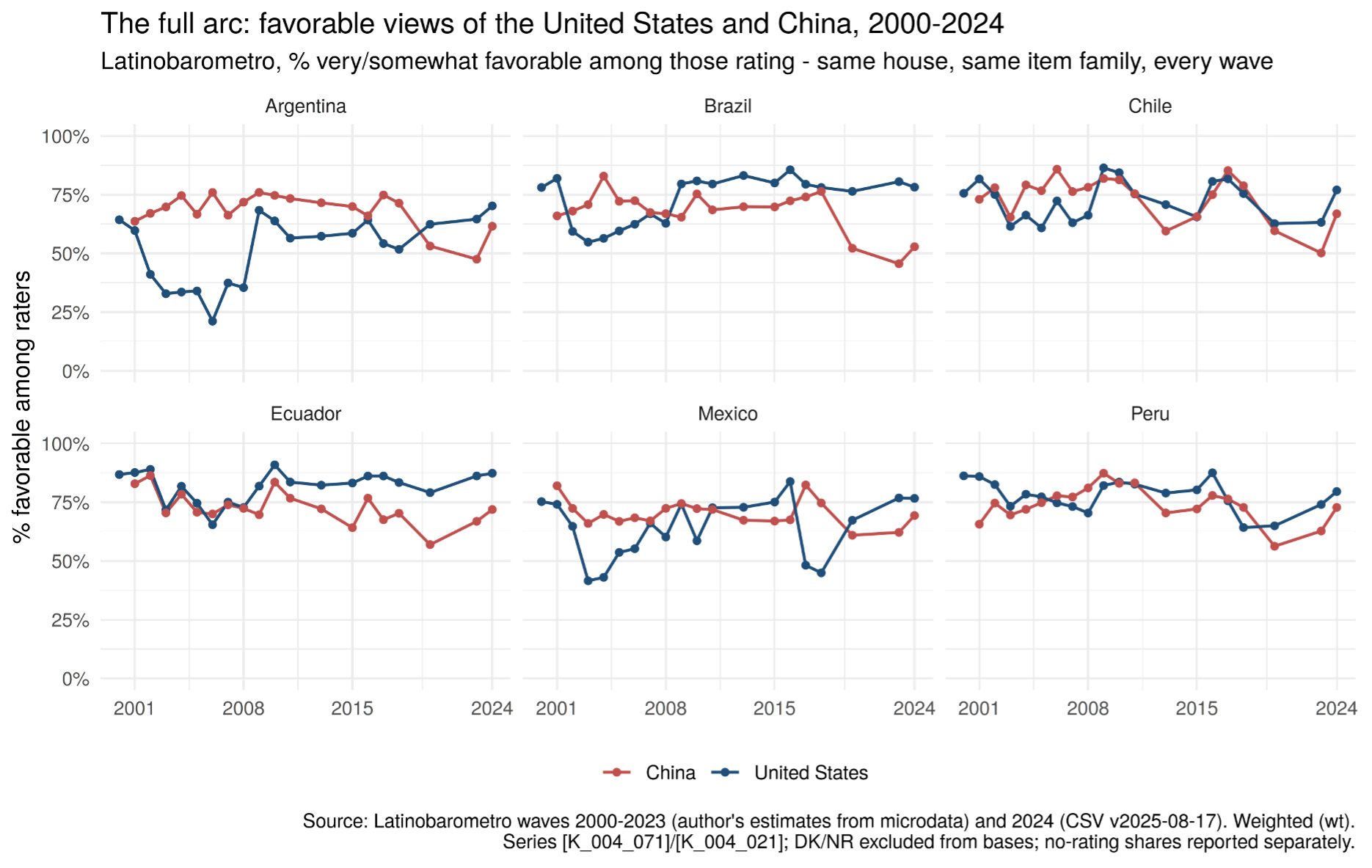
Figure 2. The full arc: favorable views of the United States and China among raters, every Latinobarómetro wave, 2000–2024.
The 2024 endpoint therefore reads differently. Yes, the United States then out-polled China among raters in all six countries — 87 to 72 percent in Ecuador, 80 to 73 in Peru, 78 to 53 in Brazil, 77 to 67 in Chile, 77 to 69 in Mexico, 70 to 62 in Argentina — reversing 2001, when China led by eight among rating Brazilians and trails by twenty-five today. But the crossing is recent, and both lines produced it. China sits below its own quarter-century norm while the United States sits at or near its series highs. The acquaintance gap closed as the share unable to rate China fell from 34 to 14 percent in Brazil and 18 to 9 in Chile. While citizens still grade the relationship and the power separately, majorities in all six countries call relations with China good, from 92 percent in Chile to 63 in Argentina.
Three lessons for policy
First, interdependence does not buy affinity, and it does not ensure it either. China's mass standing was an inheritance from before the boom; two decades as the region's indispensable economic partner added familiarity without adding affection. And when the pandemic-window shock came, economic centrality provided no cushion; the fall was steepest in Brazil, where the dependence runs deepest. For Washington, the finding cuts both ways: the United States retained a durable mass-opinion advantage in the region even where governments hedge, an asset of standing, not a guarantee of alignment. For anyone narrating Chinese soft power from trade statistics, the citizen layer is a corrective one, to be measured rather than inferred.
Second, crisis does not equal realignment. The Argentine collapse, which was the hardest test imaginable, generated internal attribution and sovereignty protection, not demand for external anchors; dollarization polled at 20 percent weeks before the fall. The pattern persists. In 2024, economically vulnerable respondents are 8 to 14 points less supportive of regional integration in four of the six countries, while Argentina — the crisis-hardened case, with the region's highest support at 91 percent — and Chile show essentially no vulnerability gap at all. Economic pain travels through domestic politics. Strategies that assume desperate publics will embrace whichever power arrives with resources misread the mechanism.
Third, support for integration is broad but generic. Seventy-nine to ninety-one percent favor integration within Latin America in 2024, yet 79 percent of respondents with views favor integration within and beyond the region alike, and pure regionalists are just 6 percent. Integration attitudes today are mostly general openness to the world, not bloc identity. The telling exceptions track treaty portfolios. Brazil, Mercosur's anchor, is the one public meaningfully more regionalist than extra-regional; Chile, the Pacific free-trader, the one meaningfully more extra-regional. The support is old as well as broad, running between 69 and 96 percent across three decades of changing wordings. Yet the post-2015 decay of the region's blocs happened on top of a durably favorable public. The crisis of Latin American regionalism is institutional, not attitudinal. Bloc-building projects cannot presume an identity constituency; they must win instrumental arguments, case by case.
Why archives are strategic infrastructure
There is a measurement finding here as consequential as the substantive ones. The items that answer today's central geopolitical question about the region were asked at its opening and then retired. Latinobarómetro's named-bloc evaluation items left the questionnaire by 2015–2018; its ask-a-citizen alignment items died by 2011; question-level screens of the strongest national-pollster candidates found no bloc items after 2015 either. The 2001 baseline exists only because the USIA cluster was archived at the Roper Center. As the rivalry intensified, the citizen-level record thinned precisely when it mattered most. Sustaining, harmonizing, and archiving this measurement is not a scholarly nicety; it is part of strategic awareness.
The road ahead
The story has not stopped moving. Pew Research Center's spring 2026 survey finds China now viewed more favorably than the United States in most of thirty-six countries, a reminder that the compression documented here can shift again, quickly. The full study turns next to the conditioning questions the harmonized series can now support, asking whose evaluations moved, in which countries, and under what economic and institutional circumstances. In December 2001, not one surveyed Brazilian placed China at the center of the country's economic life. The rest is the century so far, and the archives are how we know.
Sources and methods
2001: Surveys of the United States Information Agency series. Argentina: studies 2001-I200107 (CID/Gallup, March 9–19, N=1,200), 2001-I200128 (Gallup Argentina, September 6–9, N=1,169, weighted), 2001-I200144 (Mora y Araujo, November 23–30, N=1,200). Brazil: 2001-I200106 and 2001-I200143 (IBOPE, March 9–13 and December 13–18, N=1,200 each). Chile: 2001-I200109 and 2001-I200138 (MORI, March 29–April 4 and November 10–23, N=1,200 each, weighted; urban samples, cities over 40,000). Peru: 2001-I200154 (Apoyo, December 14–26, N=1,219, weighted). Face-to-face national adult samples except as noted. Data provided by the Roper Center for Public Opinion Research, Cornell University (iPoll and the Latin American Databank).
2001–2024: Corporación Latinobarómetro, waves 2001–2023 (estimates by the author from the wave microdata, weighted) and the 2024 wave (19,214 face-to-face interviews in 17 countries; six-country subsamples of 1,200–1,210 each, weighted). Items: opinion of the United States and China (harmonized series K_004_071/K_004_021; 2024 codes P29ST.A/C), country relations (P30ST.A/C), integration within and beyond Latin America (P32ST.A/B) and the 1997–2016 economic-integration spine, subjective income sufficiency (S5).
Percentages are computed among respondents offering a substantive rating, weighted where weights are distributed; shares unable to rate are reported in the text. Because the 2001 studies were commissioned for a U.S. government audience and the 2024 study by a regional academic program, cross-year comparisons emphasize orderings, gaps, and change rather than exact levels; the 2001 Chilean samples are urban. Analyses by the author; results are published with acknowledgment and source citation in accordance with Roper Center terms. This research was conducted through the Kohut Scholar Program at the Roper Center, which honors the legacy of Andrew Kohut.
Dayra Lascano is a Ph.D. candidate in the Department of Government at Cornell University and a 2026 Kohut Scholar at the Roper Center for Public Opinion Research.
* Artificial Intelligence (AI) was used to aid with writing and editing: drafting text and revising it for wording, clarity, and concision; data analysis: debugging the R code and formatting the figures. AI-supported tasks have received full human review